
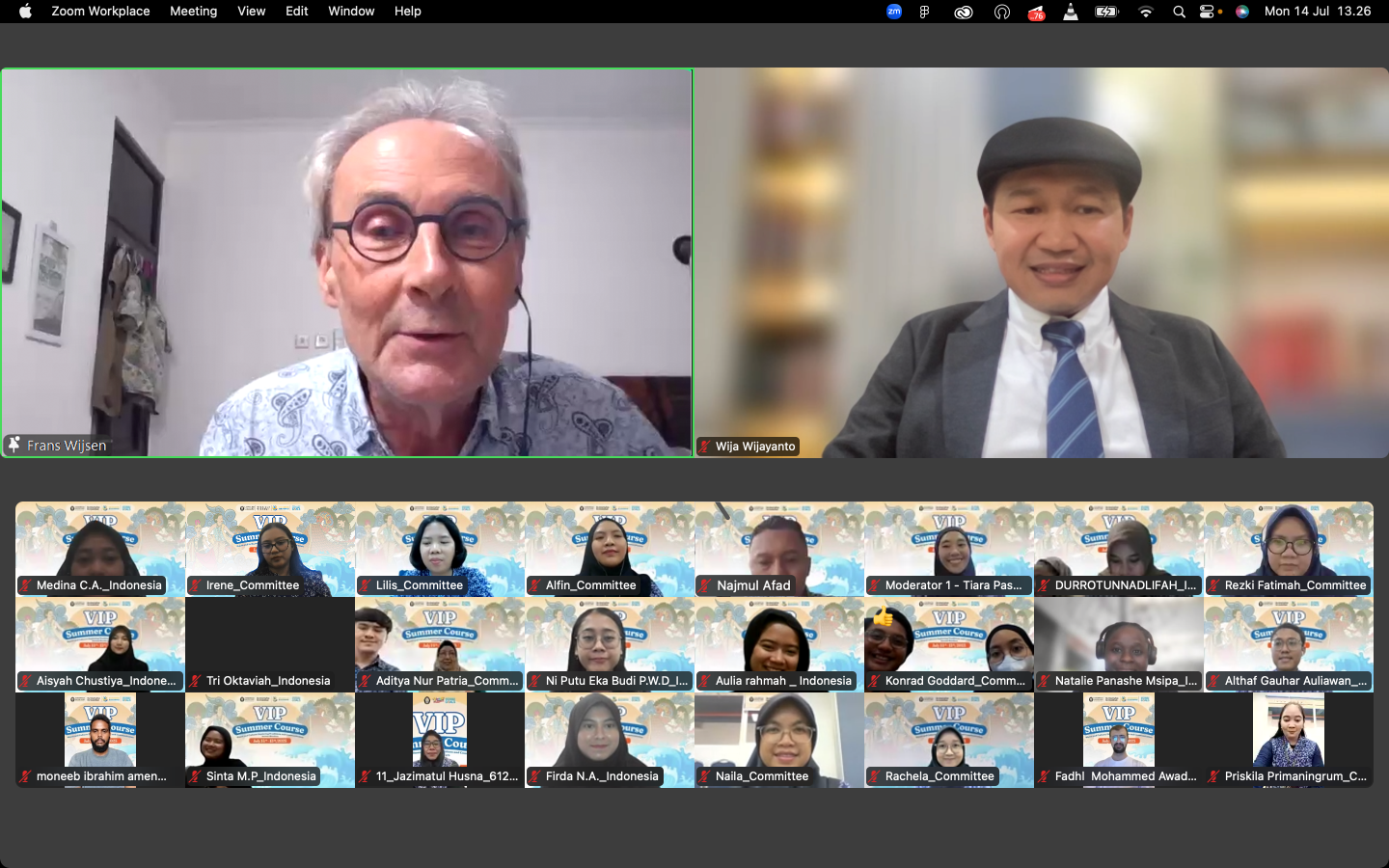
Semarang, July 15, 2025 – The Department of Information and Culture, Vocational School, Diponegoro University, successfully held the opening ceremony of the Vocational International Program (VIP) Summer Course on July 14–15, 2025, conducted online. Carrying the theme “Water and Culture: Exploring Traditions and Communications Across Borders,” this program brought together participants from around the world to explore the interrelation between water, culture, and cross-border communication.
The program attracted an impressive 99 international participants from 15 countries (Zimbabwe, Yemen, UK, Timor Leste, Gambia, Tanzania, Sudan, Republic of Korea, the Philippines, Pakistan, Myanmar, Ethiopia, Cambodia, Botswana, and Malaysia) and featured distinguished speakers from renowned institutions, including:
- Prof. Parinitha (Mangalore University, India)
- Prof. Dr. Frans Wijsen (Radboud University, Nijmegen, the Netherlands)
- Dr. Sr. Chrisia Laura Pinto (St John College of Humanities and Science, Mumbai, India)
- Prof. Dr. Erikson Saragih, S.Pd., M.Hum. (Universitas Sumatera Utara, Indonesia)
In her opening remarks, Lilis Lamsehat Panjaitan, S.Pd., M.A., Chair of the Organizing Committee, emphasized that this program goes beyond academics, serving as a space for cultural and scientific dialogue on the issue of water.
“This is a platform to share ideas, experiences, and cultural exchange. I believe our speakers will broaden your horizons beyond what you have imagined. We hope that by the end of this program, you will gain new knowledge,” she said.
Meanwhile, UNDIP Vice Rector IV, Wijayanto, S.IP., M.Si., Ph.D., highlighted water as a fundamental element touching many aspects of life—environmental, cultural, and even spiritual—sharing his personal experience in Demak, an area often affected by tidal flooding, and UNDIP’s role in developing hybrid sea dikes.
“Water is not only a scientific or environmental matter but also a cultural force and a medium of communication woven into human history. How we manage water is shaped by the way we value it, influenced by beliefs, traditions, and communication,” he remarked in his keynote speech.
Over two days, participants engaged in four main sessions:
- Travelling Across the Water and the Kind of Significance It Had in Both Cultures
- Delivered by Prof. Parinitha, this session examined the cultural meanings of crossing water, from the Black Atlantic perspective that views the sea as a symbol of power, spirituality, and solidarity, to colonial perspectives that used the sea to expand power and reinforce patriarchal structures.
- The Significance of Water in Religious and Cultural Rituals
- Prof. Dr. Frans Wijsen discussed the role of water as a symbol of purity and spiritual renewal in nearly all religions, highlighting the gap between religious teachings and real practices in environmental stewardship. He stressed the need for integration between technology, culture, and legal policies.
- Water for 3Ps: Peace, Prosperity, and Progress
- Dr. Sr. Chrisia Laura Pinto emphasized the importance of water as a source of peace, prosperity, and global progress. Beyond technical aspects, water also serves as a symbol of spirituality and international diplomacy. She encouraged participants to become “water guardians,” advocating for justice and equitable access to clean water.
- Media and Communication: Spreading the Value of Water through Media Campaigns
- In the closing session, Prof. Dr. Erikson Saragih demonstrated how media can spread the values of water through cultural and linguistic approaches, highlighting that culturally rooted water campaigns can strengthen ecological awareness and preserve human values.
The program will run for three months (July–November 2025), combining synchronous learning through Zoom sessions with speakers and asynchronous learning via the Massive Open Online Course (MOOC) platform moocs.undip.ac.id. The course includes study materials, quizzes, and participant projects.
The VIP Summer Course 2025 stands as concrete proof of UNDIP Vocational School’s commitment to fostering international collaboration in education, research, and culture. This program aims to enrich global understanding of the importance of water in social, cultural, and religious contexts, while encouraging cross-disciplinary and cross-national dialogue in addressing environmental challenges.