
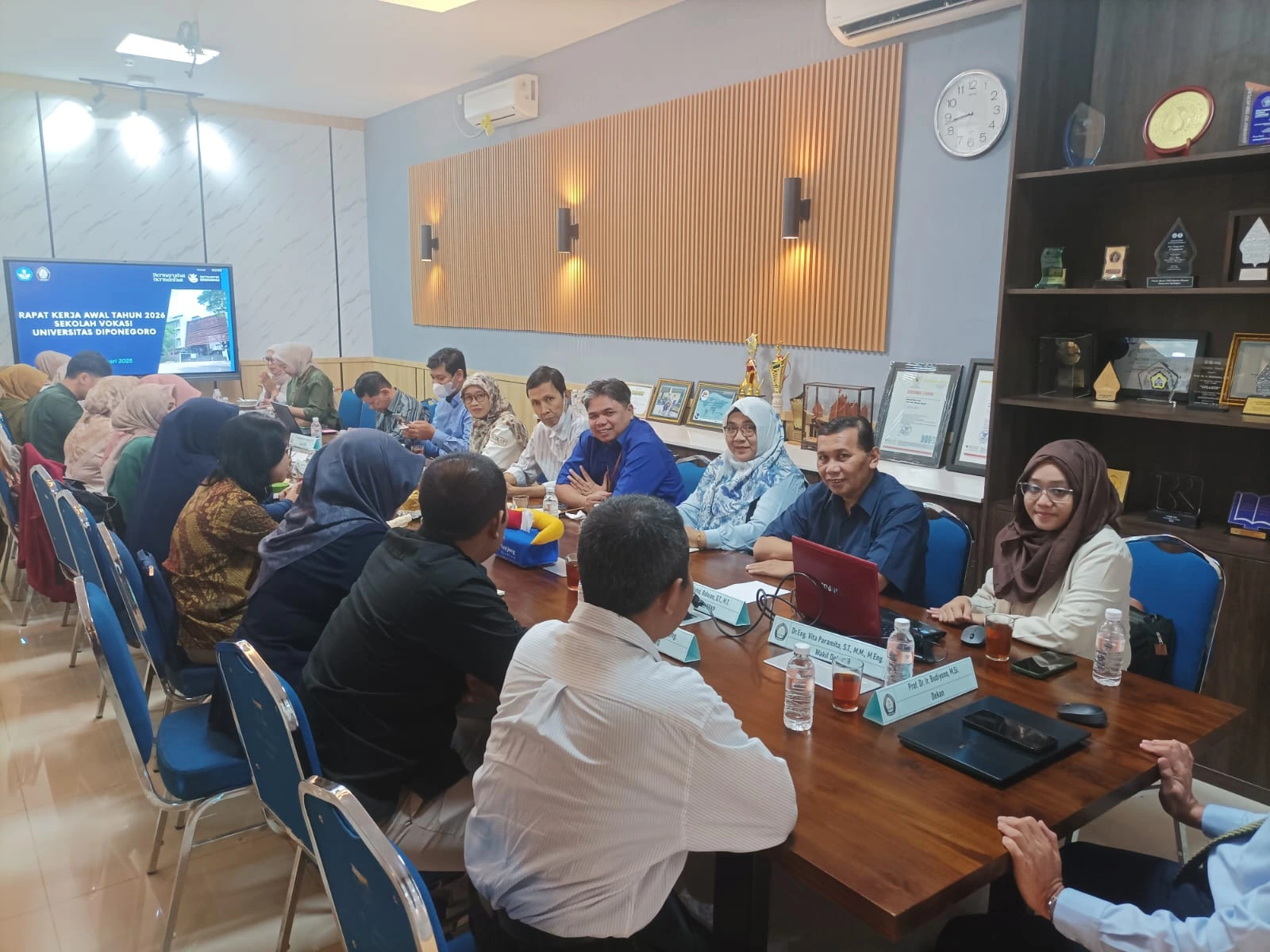
By: Prof. Dr. Ir. Budiyono, MSi – Dekan Sekolah Vokasi Universitas Diponegoro
Dean’s Strategic Direction at the Beginning-of-Year Leadership Meeting
As the year 2026 begins, the Vocational School of Diponegoro University enters a decisive phase of its institutional journey. This year is not merely a continuation of routine academic activities, but a strategic momentum for consolidation and acceleration toward a greater vision: becoming a world-class vocational school in the 2026–2030 period.
In a leadership meeting attended by Heads of Study Programs, Vice Deans, and Secretaries of Study Programs, the Dean of the Vocational School emphasized that 2026 is no longer a year for experimentation, but a year for execution. The focus must move beyond activities toward quality, impact, and reputation.
Heads of Study Programs: Academic Leaders at the Front Line
Heads of Study Programs play a pivotal role as academic leaders, not merely as administrative managers. The progress or stagnation of a study program is largely determined by the leadership capacity of its Head in shaping curriculum direction, ensuring learning quality, and mobilizing lecturers and students.
Vocational curricula must be alive and relevant. Outcome-Based Education (OBE) should not stop at documentation, but must be realized through practice-based learning, industry case studies, teaching factories, community-based projects, MSME engagement, and global workforce preparation programs. Each study program must be able to clearly articulate its identity: what its graduates excel at and what real-world problems they are able to solve.
Students must be positioned as the central subjects of education. Success is not measured solely by GPA and graduation rates, but by mental resilience, clarity of career direction, and readiness to enter the workforce, entrepreneurship, or further study. In this context, Heads of Study Programs play a crucial role in preventing student dropouts, mentoring final projects, and responding promptly to student challenges.
Vice Deans: Orchestrators of Movement and Guardians of Rhythm
Vice Deans hold a strategic function as system orchestrators. While the Dean sets the direction, Vice Deans ensure that the institutional engine runs in harmony. This role demands proactive leadership, cross-program coordination, and the courage to address emerging issues before they escalate into crises.
In academic affairs, Vice Deans are responsible for safeguarding quality and fairness—ensuring that OBE is genuinely implemented, teaching workloads are distributed proportionally, and learning evaluations are conducted consistently. In resource management, Vice Deans are expected to act as enablers, establishing governance systems for human resources, finance, and infrastructure that are efficient, transparent, and accountable, without stifling innovation and initiative.
Secretaries of Study Programs: The Backbone of Sustainability
Secretaries of Study Programs serve as the backbone of continuity and sustainability. Their role extends far beyond administrative record-keeping. They act as strategic connectors among Heads of Study Programs, lecturers, students, and faculty leadership, while also functioning as an early warning system for potential academic and administrative issues.
Mastery of academic systems, student data, scheduling, documentation, and reporting forms the foundation of this role. With these competencies, Secretaries of Study Programs become true strategic partners—supporting leadership decisions, maintaining consistency, and ensuring that study programs operate smoothly and sustainably.
Teaching Factories, Lecturers, and the JUARA Work Culture
Teaching factories and industry partnerships must not be symbolic. They must generate authentic learning experiences and tangible impacts for students and society. Each study program is encouraged to develop at least one signature program that reflects its distinctive strengths and vocational identity.
At the same time, vocational lecturers are expected to be competent, productive, and relevant—delivering practice-oriented and case-based instruction, engaging actively with industry and community service initiatives, and contributing to internationally reputable scientific publications. All of these efforts must be grounded in the JUARA work culture: Integrity, Excellence, Fairness, Responsiveness, and Adaptability.
Collective Action for a Strategic Leap
The Vocational School of Diponegoro University is not built by individual figures, but by a strong and coherent system. Heads of Study Programs lead, Vice Deans mobilize, and Secretaries of Study Programs safeguard sustainability. When these three elements work in unity, institutional transformation becomes inevitable.
The year 2026 marks a collective call to move forward together—with collaboration, courage, and a shared commitment to change. From the Vocational School of Diponegoro University, we aim to produce vocational graduates who are globally competitive, adaptive, and capable of delivering intelligent solutions for Indonesia and the world.