
Collaboration with industry partner supports applied learning and future teaching factory development
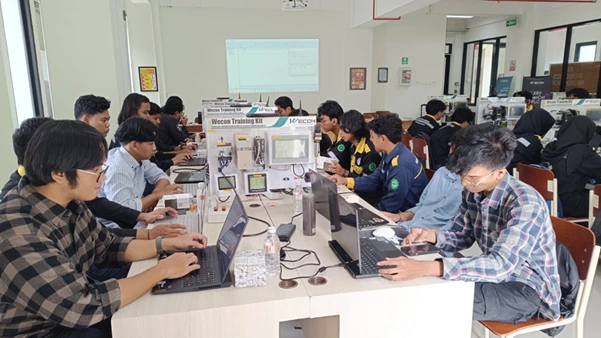
Semarang, January 20, 2026. Students and lecturers from the Automation Engineering Technology (Teknologi Rekayasa Otomasi/TRO) Study Program at the Vocational School of Universitas Diponegoro (UNDIP) participated in an industrial automation systems training program held on 19–20 January 2026 at the Teaching Factory Building of the Vocational School, UNDIP.
The training was conducted in collaboration with PT Berkat Solusindo, the official holder of the Wecon Indonesia brand. A total of 30 TRO students and all TRO lecturers took part in the two-day program, which aimed to strengthen practical competencies and align academic learning with current industrial standards.
According to Natalis Siswanto, representative of PT Berkat Solusindo, the training reflects the industry’s growing need for graduates who are familiar with real industrial automation platforms. “Industrial automation continues to develop rapidly, and industries require graduates who are not only strong in theory but also capable of operating automation systems directly,” Natalis said. “Through this training, students and lecturers gain practical experience that is highly relevant to real industrial environments.”
The program utilized Wecon industrial automation training kits, enabling participants to work hands-on with programmable logic controllers (PLC), human-machine interfaces (HMI), and integrated control systems commonly used in industrial automation.
Involving lecturers alongside students was considered essential to ensure knowledge transfer and curriculum relevance.
Priyo Sasmoko, Head of the Automation Engineering Technology Study Program, emphasized that industry-led training plays a vital role in maintaining the applied orientation of vocational education. “This training strengthens our commitment to practice-based learning in the TRO program,” Priyo said. “By engaging both students and lecturers, we ensure that our competencies and teaching approaches remain aligned with real industrial needs.”
Beyond skills development, the training also marked an important step toward deeper collaboration between the study program and industry partners. One of the strategic outcomes discussed was the potential establishment of a Teaching Factory focused on industrial automation systems.
The proposed teaching factory is expected to function not only as a learning facility for students, but also as a training and upskilling center for industrial automation systems, supporting professional training and certification programs.
The Dean of the Vocational School of Universitas Diponegoro highlighted that close collaboration with industry is a key pillar of vocational education development. “Vocational education must be closely connected with industry practices,” the Dean stated. “This training demonstrates how industry collaboration can strengthen student competencies and open opportunities to develop a teaching factory that benefits both education and industry.”
As vocational education continues to emphasize applied and industry-relevant learning, initiatives such as this training program demonstrate how collaboration can prepare graduates to enter the workforce with practical, job-ready skills while supporting long-term institutional development. (Bdy)
🏷️ Tags: Education & Skills, Vocational Education, Industrial Automation, Industry Collaboration, Teaching Factory