
By Prof. Dr. Ir. Budiyono, M.Si. — Dean, Vocational School, Universitas Diponegoro
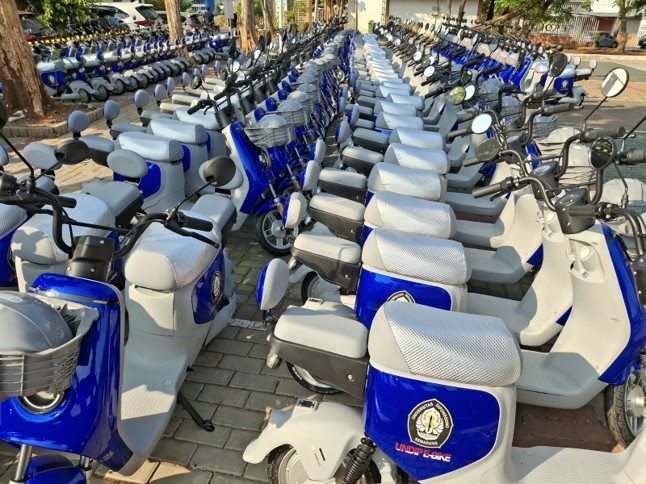
A total of 220 UNDIP E-Bikes were assembled at the Vocational School of Universitas Diponegoro with the involvement of students from several study programmes and in collaboration with technicians from WanWay Indonesia Internasional. The project demonstrates work-based learning, technology transfer, and the strengthening of student competencies in assembly, electrical systems, automation, and manufacturing. (Photo: UNDIP Vocational School Documentation)
The upcoming WorldSkills Competition Shanghai 2026 should not be seen merely as an international skills contest. For vocational education institutions, it offers a window into how rapidly global occupational standards are changing—and how closely education, technology, industry, and talent development are now interconnected.
In my recent article, “WorldSkills Shanghai 2026 dan Masa Depan Pendidikan Vokasi Indonesia”, I argued that Indonesia should regard WorldSkills as more than a competition in which participants pursue medals. It should serve as a strategic reference for strengthening the national vocational education ecosystem.
For the Vocational School of Universitas Diponegoro (UNDIP), this perspective must now be translated into institutional action. Becoming a world-class vocational school is not simply a matter of adopting an international label. It requires an educational ecosystem capable of producing internationally comparable skills, solving real-world problems, and creating measurable value for industry, society, and the environment.
1. Mapping Competencies Against Global Standards
The first priority is to examine how the competencies developed in every study programme compare with international occupational and professional standards. Curriculum review should therefore move beyond asking whether courses comply with national regulations. It should also determine whether learning outcomes, laboratory practices, project assignments, and assessment methods reflect the technologies and performance standards currently used in global industry.
This does not mean copying WorldSkills competition modules directly into the curriculum. Instead, WorldSkills standards can be used as an external benchmark to identify competency gaps, strengthen assessment rubrics, and help students understand the level of precision, speed, safety, problem-solving ability, and professionalism expected internationally.
2. Transforming Teaching Factories into Real Production Ecosystems
A teaching factory should not be defined merely by the availability of equipment or a dedicated building. Its real value lies in bringing authentic industrial problems, working standards, deadlines, users, and quality controls into the learning process. UNDIP Vocational School already has an important foundation through its teaching factories and applied-innovation units. The next step is to ensure that each unit has clear industry partners, real products or services, student involvement, measurable competency outcomes, and documented economic or social impact. The UNDIP E-Bike programme provides a relevant example. A total of 220 electric bicycles were assembled at UNDIP Vocational School with the involvement of students from several study programmes and in collaboration with technicians from WanWay Indonesia Internasional. The activity offered practical experience in assembly, electrical systems, automation, teamwork, and quality control while supporting UNDIP’s transition towards a more sustainable campus. The strategic opportunity goes further. Such projects should develop from assembly activities into platforms for reverse engineering, component improvement, maintenance systems, Internet of Things integration, product development, and applied research. This is how technology transfer can gradually become technology mastery.
3. Positioning Industry as a Co-Educator
Industry engagement must go beyond memoranda of understanding, guest lectures, and short-term internships. Industry partners should become co-educators who help define competencies, provide authentic projects, mentor students, participate in assessment, and validate graduate readiness. For UNDIP Vocational School, this means converting selected partnerships into structured co-education agreements. The responsibilities of the university and its partners should be clearly defined, including curriculum input, workplace mentoring, access to facilities and technology, joint assessment, professional certification, and recruitment opportunities. Such a model would also distinguish applied bachelor’s programmes from conventional academic programmes. Students would not simply study first and encounter the workplace later; they would learn through a continuous sequence of campus-based instruction, teaching-factory projects, and industry-based experience.
4. Developing a Graduate Skills Passport
Degrees remain important, but employers increasingly require credible evidence of what graduates can actually do. UNDIP Vocational School should therefore develop a Graduate Skills Passport that complements the diploma and academic transcript. The passport could document industry projects, teaching-factory experience, professional certifications, digital and artificial-intelligence capabilities, workplace mentor assessments, portfolios, and demonstrated technical and soft skills. Where relevant, these competencies should be mapped against professional standards and international accreditation frameworks. This would give employers a clearer picture of graduate capabilities and provide students with a portable record of achievement. It would also strengthen international employability by making competencies easier to understand and compare across institutional and national boundaries.
5. Using Artificial Intelligence Without Losing the Human Dimension
Artificial intelligence is rapidly changing technical work, business processes, and professional decision-making. Vocational education cannot treat AI as an optional addition. Every study programme must identify how AI is transforming its field and what new competencies students will need. At the same time, vocational education must retain its human foundation. Technical accuracy, safety awareness, ethical judgement, teamwork, communication, discipline, and responsibility cannot be delegated to machines. UNDIP Vocational School should therefore adopt a human-centred approach to AI: using it to support design, simulation, diagnosis, data analysis, predictive maintenance, personalised learning, and assessment, while establishing clear principles for academic integrity, data protection, safety, and professional accountability.
From International Recognition to Real-World Impact
World-class status will not be achieved through rankings, certificates, or international agreements alone. It will be demonstrated by the quality of graduates, the relevance of institutional partnerships, the solutions produced through applied research, and the tangible impact created by teaching factories. WorldSkills Shanghai 2026 gives us an important point of reference, but the decisive work must take place within our own institution: in classrooms, laboratories, workshops, teaching factories, industry projects, and graduate career pathways. The road ahead requires collective commitment from lecturers, students, educational staff, alumni, industry partners, and university leaders. Each has a role in building an ecosystem in which skills are not only taught, but also tested, recognised, and applied to real challenges. For UNDIP Vocational School, this is the essential meaning of our direction towards a world-class vocational school:
Vocational Skills to Real-World Impact.