
SEMARANG – The Vocational School of Universitas Diponegoro (UNDIP) continues to strengthen its international academic network as part of its transformation toward becoming a World-Class Vocational School. One of these efforts was demonstrated through the World Class University (WCU) Visiting Professor Program featuring Prof. Hao Liu from the Graduate School of Engineering / Center for Aerial Intelligent Vehicles, Chiba University, Japan, on Wednesday, September 30, 2026.
Organized by the Applied Bachelor Program in Automation Engineering Technology, Department of Industrial Technology, UNDIP Vocational School, the program carried the theme “Bio Inspired Engineering for Sustainable IoT Innovation Through the B3 Strategy.”
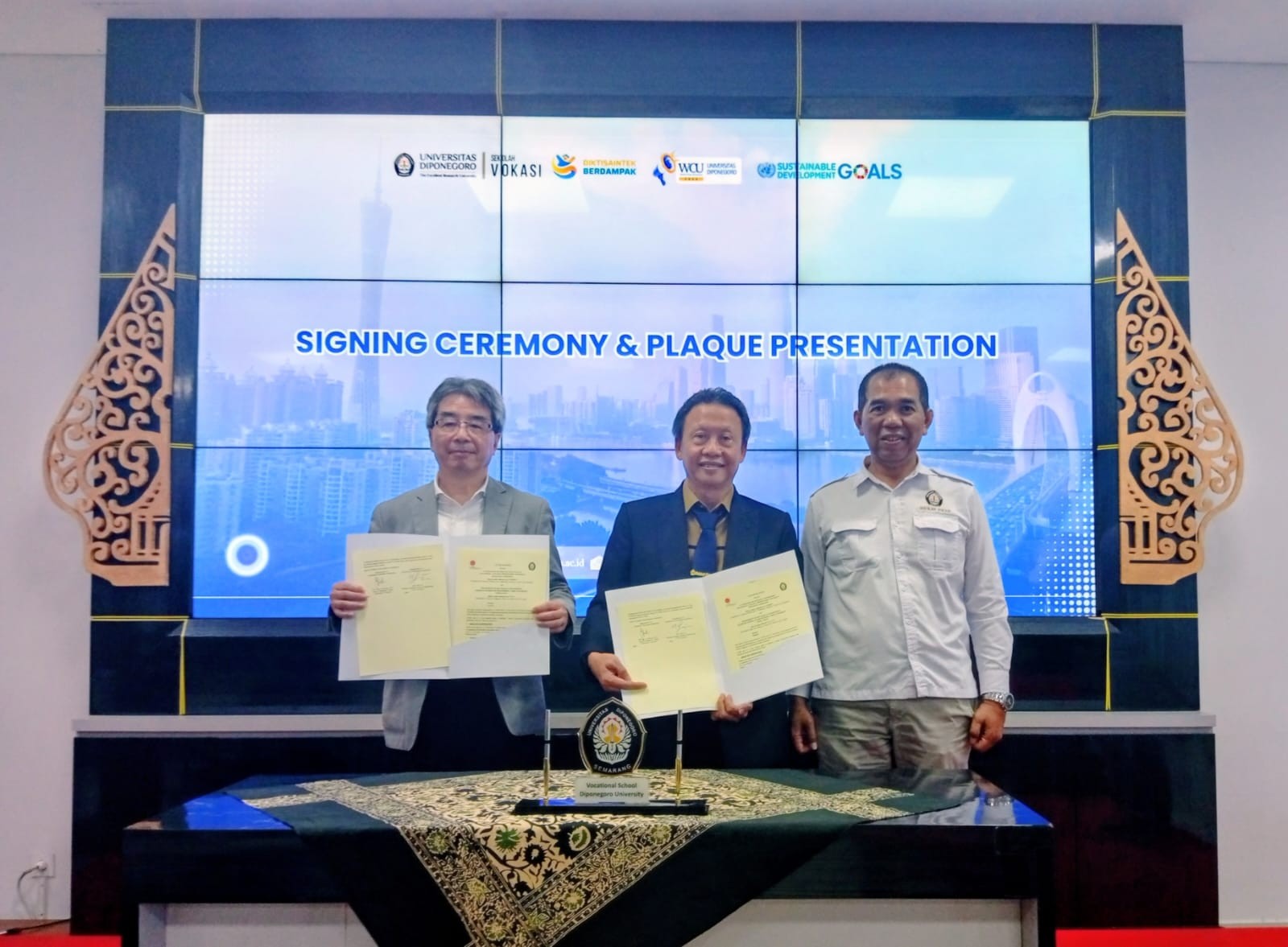
In addition to knowledge sharing and academic discussion, the event also included the signing of a collaboration document and a plaque presentation, marking another step in strengthening academic relations between UNDIP Vocational School and its partner in Japan.
The Dean of UNDIP Vocational School, Prof. Dr. Ir. Budiyono, M.Si., emphasized that the rapid development of technology—from Artificial Intelligence and the Internet of Things (IoT) to automation and robotics—must go hand in hand with sustainability.
According to him, the challenge for higher education today is not only to develop more advanced technologies, but also to ensure that technology contributes to a better and more sustainable future.
“Technology should not only make our life easier, but also make our future better,” Budiyono said.
Not Enough to Know, We Must Be Able to Do
Budiyono also highlighted one of the key characteristics of vocational education: learning should not stop at knowledge.
Vocational students, he said, should be able to transform knowledge and technology into practical competencies and use them to solve real-world problems.
“For vocational education, it is not enough to know. We must also be able to do,” he said.
This principle is increasingly important as AI, IoT, automation, and other emerging technologies continue to develop rapidly. Vocational education must therefore remain closely connected to technological development, industry needs, applied research, and global academic networks.
Budiyono added that the journey toward becoming a World-Class Vocational School should not be measured only by international recognition.
“Becoming world-class is not only about international recognition. It is also about international collaboration,” he said.
Through international collaboration, students and lecturers can exchange knowledge, broaden their perspectives, develop joint research, and engage directly with academics and institutions from other countries.
Part of the Journey Toward a World-Class Vocational School
The Head of the Automation Engineering Technology Study Program at UNDIP Vocational School, Priyo Sasmoko, S.T., M.Eng., said that the Visiting Professor Program is part of the study program’s efforts to strengthen the internationalization of education and support the Vocational School’s journey toward becoming a World-Class Vocational School.
According to Priyo, engaging international academics provides students and lecturers with new perspectives on technological development while opening opportunities for wider collaboration.
He hopes that such collaboration will go beyond guest lectures and develop into joint academic activities, research, knowledge exchange, innovation development, and other forms of international cooperation.
Prof. Hao Liu: Happy to Continue Sharing Knowledge and Experience
Meanwhile, Prof. Hao Liu welcomed the growing collaboration with UNDIP Vocational School. He expressed his pleasure in having the opportunity to share knowledge, experience, and technological developments with lecturers and students at UNDIP.
According to him, knowledge exchange among universities is an important part of advancing technology and innovation, particularly as today’s global challenges are becoming increasingly complex and require collaboration across countries and disciplines.
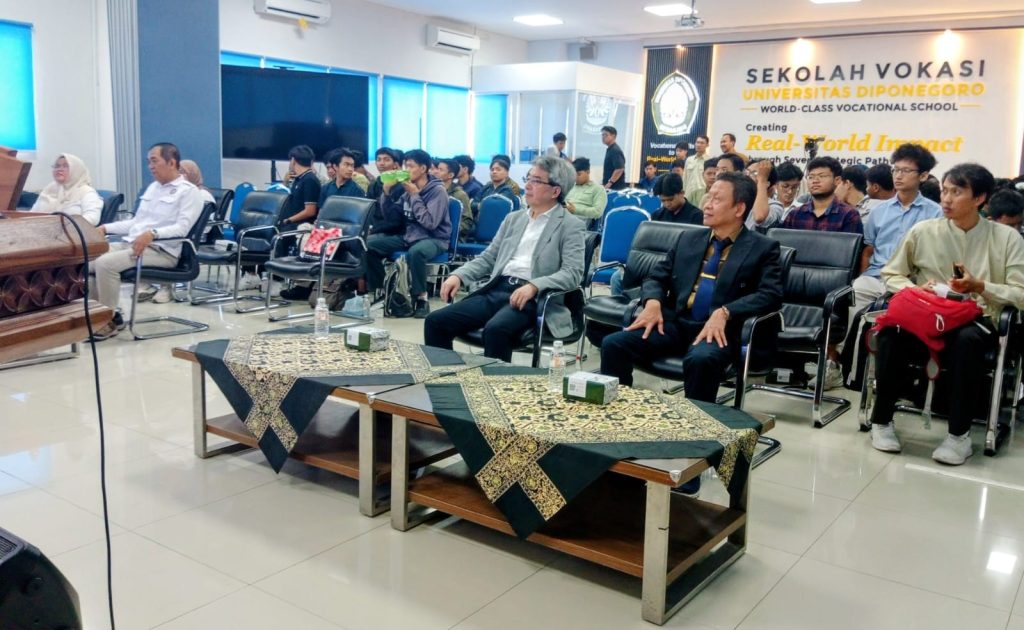
During the program, Prof. Hao Liu shared his perspectives on bio-inspired engineering and its potential application in developing more sustainable IoT innovation through the B3 Strategy. Direct interaction with international academics is expected not only to broaden students’ knowledge but also to encourage them to engage confidently with global developments in science and technology.
From Visiting Professor to Sustainable Collaboration
UNDIP Vocational School expects this program to further strengthen its relationship with Chiba University and create opportunities for broader collaboration in the future.
Potential areas of collaboration include joint research, faculty collaboration, student activities, knowledge exchange, innovation development, and joint academic programs that can provide mutual benefits for both institutions.
For UNDIP Vocational School, internationalization is not the final goal. Global networks should serve as a pathway to improve the quality of education, strengthen applied research and innovation, and provide students with meaningful international experiences.
Therefore, the journey toward becoming a World-Class Vocational School is not simply about how many international connections an institution has. More importantly, it is about how those connections can create competence, innovation, collaboration, and real-world impact. Vocational Skills to Real-World Impact.