
Semarang – The Vocational School of Universitas Diponegoro reaffirmed its commitment to industry-based vocational education through the successful organization of a Workshop, Exhibition, and Launching of the Automation and Robotic Development Center (ARDC).
The event brought together more than 80 partners, including representatives from industries, higher education institutions, and vocational high schools (SMKs). This strong participation reflects a growing collaborative spirit in building a vocational education ecosystem that aligns with the needs of modern industry, particularly in automation and robotics.
In his remarks, the Dean of the Vocational School emphasized that vocational education must continuously move closer to the real working environment. The closer the learning process is to industrial practice, the more prepared graduates will be to face future challenges.
“If we want Indonesia’s industry to be strong, we must start with vocational education that is truly close to the world of work,” he stated.
The Dean also highlighted the importance of a structured and sustainable educational pathway—from SMKs to vocational higher education, and ultimately to industry. SMKs serve as the foundation for basic skills, while vocational education strengthens and refines competencies to meet the demands of modern industry.
“The Automation and Robotic Development Center is not merely a facility, but a real bridge between campus and industry. Here, students do not only learn theory, but also work and solve real-world problems as they would in industry,” he added.
The event was attended by key industry partners, including PT Berkah Solusindo and Wekon Technology, whose presence further strengthens the global dimension of vocational education development at UNDIP.
One of the highlights of the event was a presentation by Wekon Technology, delivered by Mr Michelin, who emphasized the importance of adopting automation technologies to enhance efficiency, productivity, and global competitiveness in today’s industrial landscape.
Meanwhile, the Head of the Automation Engineering Technology Study Program, Priyo Sasmoko, stated that the program has consistently developed the Teaching Factory concept, which is now further strengthened through ARDC. This is implemented through industry-based curriculum development, hands-on learning, and active collaboration with industry partners.
The event continued with presentations from faculty members of the Automation Engineering Technology Program, showcasing innovations in automation and robotics, as well as the role of ARDC in enhancing student competencies. The session was further enriched by insights from PT Berkah Solusindo on real-world industrial technology implementation.
Another important milestone during the event was the signing of cooperation agreements between the UNDIP Vocational School and Wekon Technology, PT Berkah Solusindo, along with several other industry partners. These agreements mark a concrete step toward long-term collaboration, covering curriculum development, internship programs, and graduate recruitment opportunities.
Through the launch of the Automation and Robotic Development Center (ARDC), the UNDIP Vocational School further strengthens its position as an adaptive, collaborative, and industry-oriented institution. ARDC is expected to become a leading learning model in producing graduates who are job-ready, innovative, and globally competitive.
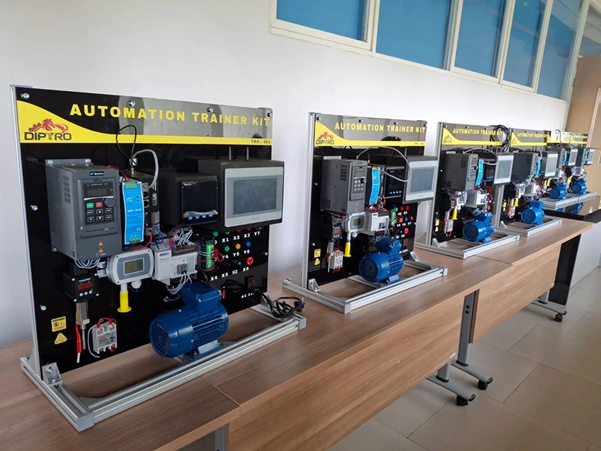
*Image Caption. Automation Trainer Kits showcased during the launch of the Automation and Robotic Development Center (ARDC) at UNDIP Vocational School, supporting industry-based learning in automation systems, control, and real-world applications.