
Reflections on the Ideas of Prof. Dato’ Seri Ir. Dr. Zaini Ujang
Workshop on Accelerating Diponegoro University Towards the Global Top 500 Universities
In discussions about world-class universities, attention is often drawn to measurable indicators such as global rankings, research publications, citations, international collaborations, reputation, and the number of international students. These indicators are undoubtedly important because they reflect institutional achievements.
Yet, a more fundamental question deserves our attention.
What truly distinguishes a world-class institution from all others?
The answer may not lie primarily in larger budgets, more sophisticated laboratories, or more impressive buildings. While these resources are important, they are not the true source of institutional excellence.
World-class institutions are ultimately distinguished by a culture of excellence that shapes the mindset and behavior of everyone within the institution.
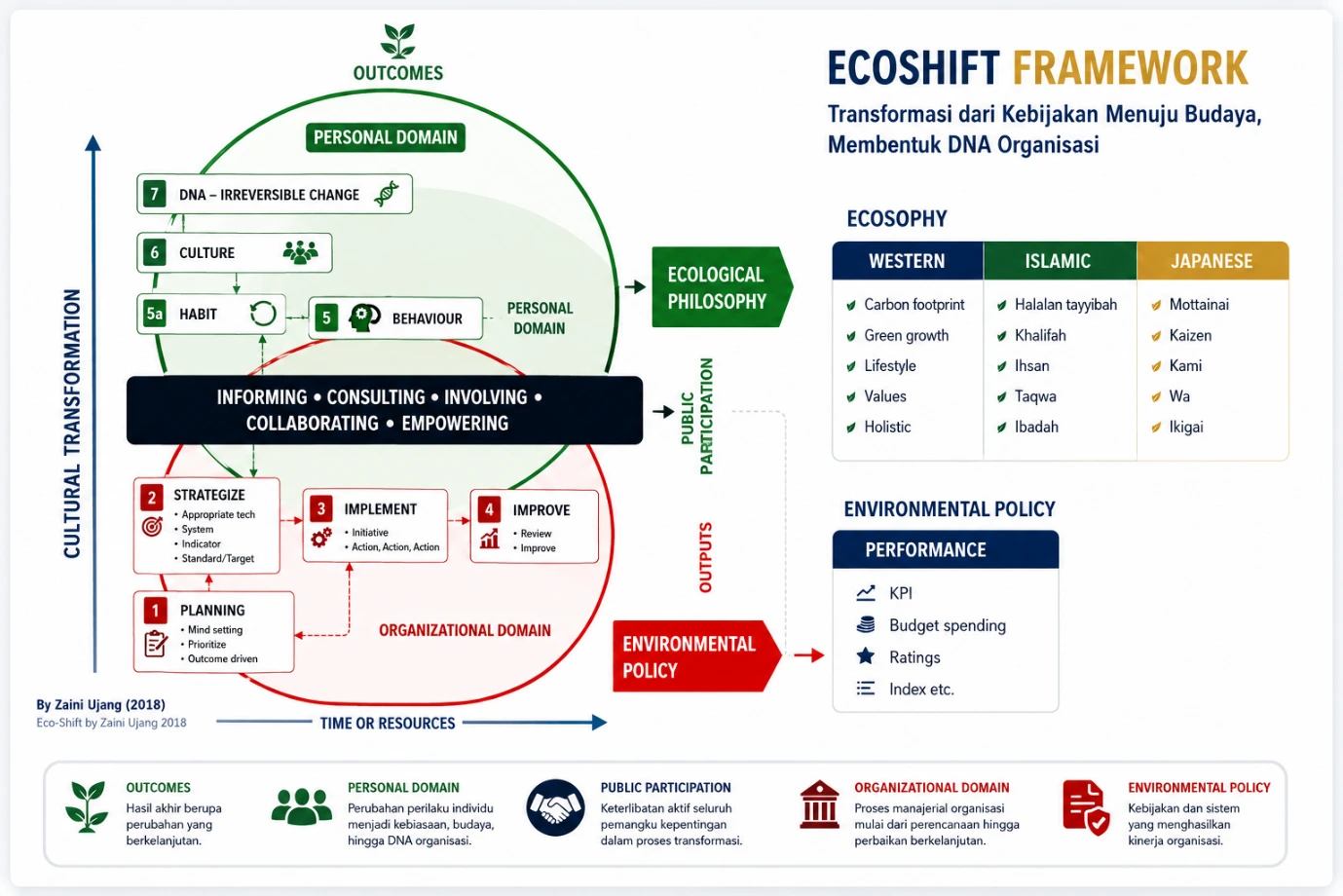
This was one of the most inspiring messages delivered by Prof. Dato’ Seri Ir. Dr. Zaini Ujang through his ECOSHIFT Framework. Although originally developed in the context of sustainability transformation, the framework provides valuable insights into how higher education institutions can create lasting organizational excellence.
Transformation Does Not End with Policy
According to the ECOSHIFT Framework, institutional transformation begins with organizational transformation.
Institutions develop strategic plans, formulate policies, implement initiatives, monitor progress, and continuously improve their systems. These processes produce organizational outputs in the form of governance structures, performance indicators, regulations, and institutional programs.
However, these outputs alone do not create transformational change.
Real transformation begins when policies change people.
Through continuous informing, consulting, involving, collaborating, and empowering, institutions gradually influence how people think and behave.
Repeated behavior develops into habits.
Habits evolve into organizational culture.
Over time, that culture becomes the institution’s DNA—its enduring identity that continues beyond individual leaders or organizational structures.
This is the highest stage of institutional transformation.
Programs may change. Policies may evolve. But institutional DNA remains the foundation of long-term excellence.
Excellence Ecosystems as the Engine of Transformation
This perspective offers valuable inspiration for the development of the Vocational School of Diponegoro University (UNDIP).
In recent years, the Vocational School has introduced seven interconnected Excellence Ecosystems:
- Academic Excellence Ecosystem
- Industry Engagement Ecosystem
- Global Employability Ecosystem
- Character Development Ecosystem
- Innovation and Applied Research Ecosystem
- Applied Media and Global Visibility Ecosystem
- Sustainability and Social Impact Ecosystem
These ecosystems should not be viewed merely as strategic programs.
They are transformation mechanisms designed to build institutional culture and ultimately shape the DNA of a World-Class Vocational School.
For example, the Academic Excellence Ecosystem is not simply about improving teaching quality. Its deeper purpose is to cultivate an academic culture committed to continuous improvement and lifelong learning.
The Industry Engagement Ecosystem goes beyond increasing partnerships. It encourages every academic activity to remain relevant to the evolving needs of industry and society.
Similarly, the Innovation and Applied Research Ecosystem promotes a culture in which research is expected to generate practical solutions and measurable impact.
The Applied Media and Global Visibility Ecosystem is designed not merely to increase international exposure but to foster a habit of communicating institutional achievements and sharing knowledge with the global community.
Meanwhile, the Character Development Ecosystem strengthens integrity, professionalism, discipline, collaboration, and performance orientation as core institutional values.
Finally, the Sustainability and Social Impact Ecosystem reinforces the belief that environmental stewardship and social responsibility should become integral parts of institutional identity rather than isolated initiatives.
From Programs to Culture
The success of institutional transformation should not be measured solely by the number of completed activities or achieved performance indicators.
Its true measure is whether those initiatives change the way people think, work, collaborate, and make decisions.
When lecturers naturally pursue international collaboration…
When students instinctively seek solutions to real-world problems…
When professional staff continuously improve service quality…
When innovation becomes a daily habit rather than a special project…
When sustainability becomes part of campus life rather than a campaign…
Then transformation has moved beyond programs.
It has become culture.
And when culture becomes shared identity, it forms the DNA of a World-Class Vocational School.
Building the Future from Within
World-class institutions are not built solely through investments in infrastructure or technology.
They are built through sustained investment in people, values, leadership, and organizational culture.
For this reason, the journey of the Vocational School of Diponegoro University toward becoming a World-Class Vocational School is not merely about achieving international benchmarks.
It is about nurturing an institutional culture that inspires every lecturer, staff member, student, alumnus, and partner to pursue excellence every day.
Through the implementation of the Excellence Ecosystems, every initiative is expected to become more than an administrative program. Each ecosystem should contribute to shaping behavior, strengthening institutional culture, and ultimately building an enduring organizational DNA characterized by excellence, innovation, integrity, sustainability, and global relevance.
Conclusion
The key message inspired by Prof. Zaini’s presentation is remarkably simple yet profoundly important.
Great institutions are not defined by the number of programs they implement. They are defined by the culture those programs create.
The greatest challenge, therefore, is not designing more initiatives but ensuring that every initiative transforms behavior, strengthens culture, and reinforces institutional identity.
Programs create activities.
Culture creates excellence.
DNA creates world-class institutions.
When the Excellence Ecosystems consistently shape institutional culture, they gradually build the DNA of a World-Class Vocational School—an identity that endures across generations and continues to inspire excellence long into the future.