
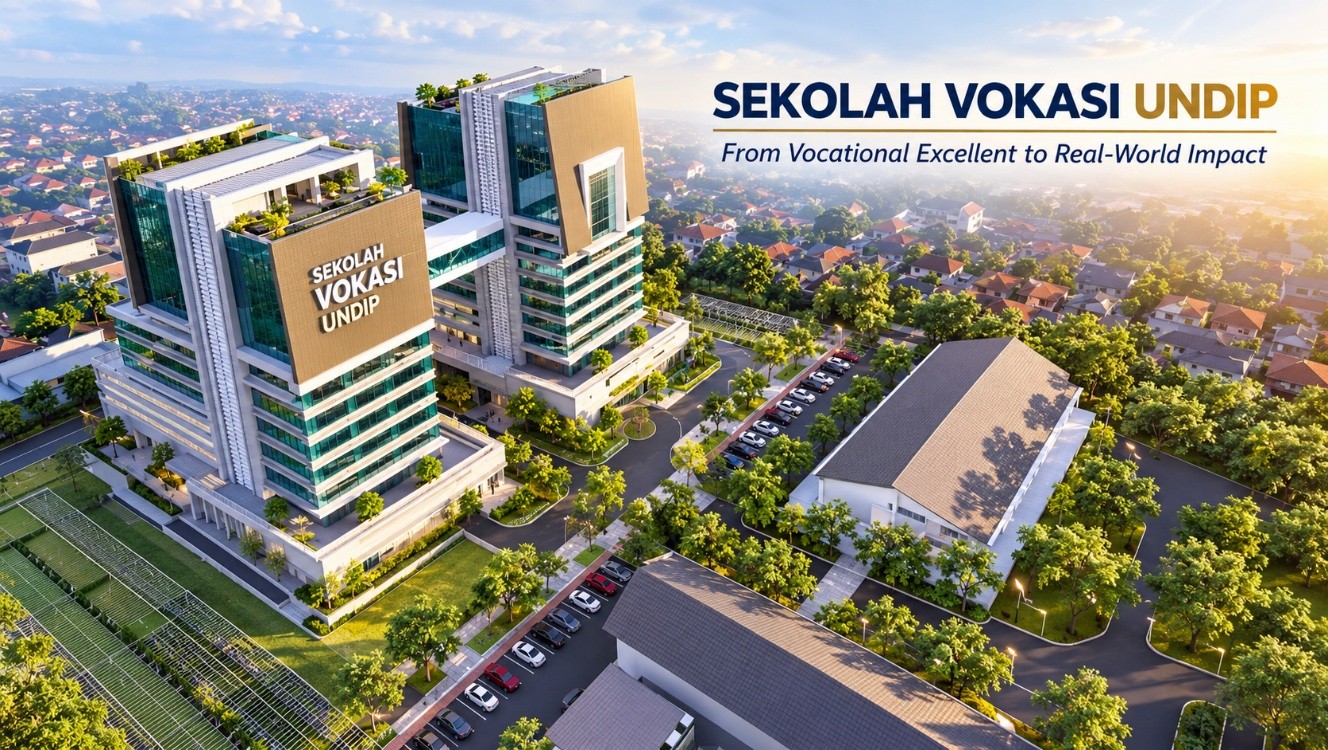
Reflections on Ten Years of UNDIP Vocational School and the Journey Towards World Class Vocational School Actualization
By: Prof. Dr. Ir. Budiyono, M.Si.
Professor of Chemical Engineering and Dean, Vocational School of Diponegoro University (UNDIP)

Ten years is an important milestone for an institution to reflect on the journey it has taken and to consider what should come next. For the Vocational School of Universitas Diponegoro (UNDIP), a decade since its establishment in 2016 is more than a marker of institutional age. It is an opportunity to ask: What have we built? Where are we heading? And what is the purpose of all the excellence we have pursued?
From the beginning, UNDIP Vocational School has carried the vision of “Becoming an Excellent and Internationally Recognized Center for Vocational (Applied) Education.” This vision provided an important direction during the School’s formative and developmental years. As a relatively new institution, the Vocational School needed strong institutional foundations, continuous improvement in educational quality, close engagement with the world of work, and the ambition to use international standards as a reference for its development.
This vision has guided the Vocational School throughout its first decade. However, as the institution matures and the higher education landscape continues to change rapidly, an important question arises: Is it time to revisit the vision that guided our first ten years as we prepare the Vocational School for its next decade?
This question does not suggest that the previous vision has lost its meaning. On the contrary, it is precisely because the past decade has brought significant progress that we now have a stronger foundation from which to look towards a broader horizon.
From Consolidation to Strengthening
Since 2016, the development of UNDIP Vocational School has been guided by a long-term development framework. This direction was formally established through Decree of the Dean of the Vocational School, Universitas Diponegoro, Number 215/UN7.5.13/SK/2021 concerning the 2016–2040 Long-Term Development Plan of the Vocational School, Universitas Diponegoro.
Within this long-term framework, the development of the Vocational School has been designed in several stages.
The period of 2016–2021 was the Vocational School Consolidation Phase. During this period, the focus was on consolidating the institutional foundations of vocational education: organizational structures, study programs, human resources, academic systems, learning facilities, and the identity of the Vocational School as an important part of Universitas Diponegoro.
The period of 2021–2026 then became the Vocational School Strengthening Phase. As the institutional foundations became more established, the focus shifted towards strengthening academic quality, institutional capacity, industry partnerships, applied learning, innovation, internationalization, and the vocational education ecosystem as a whole.
The first ten years, therefore, have essentially been a journey from consolidation to strengthening—from building institutional foundations to developing capacity and excellence.
But the journey does not end there.
Within this long-term development framework, the Vocational School is moving towards the World Class Vocational School phase for 2025–2030, followed by the World Class Vocational School Actualization phase for 2030–2035.
These next two phases provide a new context for reconsidering the vision of the Vocational School. If the Consolidation Phase focused on building the foundation and the Strengthening Phase on developing capacity and excellence, the World Class Vocational School phase moves the institution towards global standards and connectivity. The World Class Vocational School Actualization phase then demands something further: how can the excellence we have built be translated into meaningful work, solutions, benefits, and real-world impact?
After Achieving Excellence, What Comes Next?
For many years, terms such as excellence, internationalization, and world class have represented important aspirations for higher education institutions. These aspirations remain relevant. Educational institutions must maintain high academic standards, gain credible recognition, build international networks, and ensure that their graduates possess competencies that are recognized across different parts of the world.
However, excellence should not be the final destination.
A more fundamental question follows:
What is excellence for?
The same applies to the idea of being world class. The world should not merely be a place where we seek recognition or compare our position with others. It should also be a space where we create, contribute, and make a difference.
Therefore, the journey towards becoming a World Class Vocational School should lead to another question: How can world-class excellence be translated into meaningful work, solutions, benefits, and real-world impact?
This is where World Class Vocational School Actualization gains a deeper meaning. Actualization should not simply mean becoming increasingly recognized as a world-class institution. It should mean transforming the capacity and excellence we have built into something that truly works in the real world.
The long-term journey can therefore be understood through a simple progression:
Consolidation → Strengthening → World Class → Actualization → Impact.
Consolidation builds the foundation. Strengthening develops capacity and excellence. World Class brings the institution towards global standards and connectivity. Actualization transforms excellence into action. Ultimately, that action should create real-world impact.
In other words:
World class is the standard. Real-world impact is the purpose.
Dignity and Benefit
This orientation is closely connected to the identity of Universitas Diponegoro: Bermartabat dan Bermanfaat—Dignified and Beneficial.
These two simple ideas carry profound meaning for vocational education.
Vocational education should not merely produce people who know how to do things. It should develop people who possess expertise, apply that expertise professionally and responsibly, and create benefits through what they know and what they can do.
Therefore, expertise cannot be separated from dignity.
The ability to design technology, operate systems, build infrastructure, manage information, create products, or provide professional services must go hand in hand with integrity, ethics, social responsibility, and a commitment to sustainability.
Within the context of vocational education, the spirit of Dignity and Benefit can take a more concrete form:
dignified expertise, meaningful work, and real impact.
From this perspective, excellence does not need to be abandoned. Excellence remains an essential standard. What changes is how we understand its ultimate purpose.
If our earlier question was “How can we become excellent?”, the question for our second decade becomes “What do we do with that excellence?”
Rethinking the Vision of the Vocational School
Within this context, it is appropriate to revisit the vision of UNDIP Vocational School.
Not to disconnect ourselves from the journey we have already made, but to continue it.
The previous vision helped guide the Vocational School through the Consolidation and Strengthening phases. As our foundations become more established and our institutional capacity grows stronger, our orientation can evolve from building excellence towards turning excellence into impact.
As a contribution to the discussion for the School’s second decade, the vision could be reformulated as:
“To become an excellent vocational school that develops expertise with dignity to create real-world impact for Indonesia and the world.”
This formulation retains the word excellent, because quality and excellence remain essential. Excellence, however, is no longer positioned as the final destination.
Expertise is central because it represents one of the defining characteristics of vocational education. Dignity provides the ethical foundation for developing and applying that expertise. Real-world impact answers the fundamental question of why excellence and expertise are developed in the first place.
The phrase “Indonesia and the world” also carries an important message. Vocational education must remain strongly rooted in the needs of Indonesia while developing the capacity to create and contribute within a global ecosystem.
From this perspective, internationalization also takes on a broader meaning. If being internationally recognized previously represented a standard to be achieved, global connectivity in the next phase should also become a pathway for expanding our contribution.
The world is not only our benchmark. The world is also our arena for contribution.
Four Missions to Turn the Vision into Action
A vision only becomes meaningful when it is translated into action. Therefore, as part of this reflection, the reformulated vision could be supported by four interconnected missions.
First, to provide excellent, relevant, and adaptive vocational education that develops competent and dignified graduates who are capable of contributing globally.
Second, to develop strategic partnerships with industry and the world of work to strengthen learning, innovation, and shared value creation.
Third, to advance applied research and innovation to create solutions that deliver real impact for industry, society, and the environment.
Fourth, to build an academic ecosystem founded on integrity and sustainability that strengthens character, social responsibility, and environmental awareness.
These four missions carry four simple messages: the people we educate, the partnerships we build, the solutions we create, and the values we uphold.
In vocational education, these dimensions cannot be separated.
Industry, for example, should not simply be viewed as an employer of graduates or a place for student internships. Industry needs to become part of the educational ecosystem itself—contributing to learning, competency development, innovation, and shared value creation.
The same principle applies to applied research. Its success should not be measured solely by publications, patents, or prototypes. The real challenge is ensuring that knowledge and innovation find pathways towards application and contribute to solving real problems.
Seven Ecosystems, One Direction
To turn its vision and missions into reality, the Vocational School requires strong and interconnected ecosystems. This direction has already been formally embedded in the School’s institutional development.
In 2026, UNDIP Vocational School formally established the Ecosystem of Excellence of the Vocational School, Universitas Diponegoro, for 2026–2030 in Support of the Development of a World Class Vocational School, through Decree of the Dean of the Vocational School, Universitas Diponegoro, Number 104/UN7.M2/HK/VI/2026.
The framework consists of seven ecosystems: Academic Excellence Ecosystem, Industry Engagement Ecosystem, Global Employability Ecosystem, Character Development Ecosystem, Innovation and Applied Research Ecosystem, Applied Media and Global Visibility Ecosystem, and Sustainability and Social Impact Ecosystem.
These seven ecosystems are not separate spaces. They are interconnected and mutually reinforcing components moving the Vocational School in one common direction.
Academic excellence must be connected with industry. Industry engagement strengthens educational relevance and global employability. Applied research and innovation must find pathways towards implementation. Character development ensures that expertise is applied with dignity and responsibility. Sustainability and social impact ensure that progress benefits not only the institution but also society and the environment.
The Applied Media and Global Visibility Ecosystem plays a slightly different role because it works across all the other ecosystems. Visibility is not the final goal. It is a means of ensuring that the Vocational School’s work, innovation, good practices, and impact are communicated, shared, replicated, and their benefits expanded nationally and globally.
The orientation, therefore, is not simply visibility for recognition, but visibility for greater impact.
In this sense, the seven Ecosystems of Excellence are not ends in themselves. They serve as the engine that transforms excellence into impact.
Entering the Second Decade
The first ten years of UNDIP Vocational School have been a journey of building and strengthening the institution. Much work, of course, remains to be done. Academic excellence must continue to grow, industry partnerships must become more substantive, graduate quality must continuously improve, innovation must become increasingly productive, and global networks must continue to expand.
But as the Vocational School enters its second decade, it also needs a broader horizon.
A World Class Vocational School should not end with recognition. It should represent the capacity that enables the institution to make an increasingly meaningful contribution.
World Class Vocational School Actualization can therefore become the phase in which excellence is truly translated into action: when education develops people who are capable of meaningful work, when partnerships create shared value, when research produces solutions, when innovation is put into use, and when institutional activities generate benefits for society and the environment.
From this perspective, reformulating the vision is not a change of direction. It is an evolution of the long-term journey that has been designed and developed throughout the past decade.
Precisely because the foundations have been consolidated and institutional capacity has been strengthened, the Vocational School now has the opportunity to raise the level of its questions.
From “How excellent are we?” to “What is our excellence for?”
From international recognition to global contribution.
From world class to real-world impact.
Ultimately, the true measure of an educational institution may not lie only in how highly it is recognized or how widely its name is known.
There is a more fundamental question:
What has changed for the better because UNDIP Vocational School exists?