
From an Ecosystem of Excellence to Real-World Impact
By Prof. Dr. Ir. Budiyono, M.Si.
Professor of Chemical Engineering and Dean, Vocational School of Diponegoro University (UNDIP)
What does it truly mean to become a World-Class Vocational School?
Does a vocational school become world-class when it earns international accreditation? When more of its students study abroad? When its faculty members become increasingly engaged in global networks? Or when its name becomes better known among universities and industries across countries?
All of these matter. But for us, becoming world-class cannot stop at global recognition.
There is something more fundamental.
A world-class vocational school is an institution capable of transforming knowledge into competence, competence into tangible work, tangible work into solutions, and solutions into real-world impact.
This is how the Vocational School of Diponegoro University understands its journey toward becoming a World-Class Vocational School.
It is not simply a status to be achieved, but a continuing process of transformation.
A Decade of Progress, A New Chapter
The Vocational School of Diponegoro University was established in 2016. A decade later, that journey is entering a new phase.
The first ten years have been dedicated to building foundations, strengthening the institution, developing study programs, improving the quality of learning, expanding industry networks, establishing facilities and teaching factories, and fostering applied research and innovation.
As we enter the 2026–2030 period, the question is no longer simply how to become a good vocational school.
The question has become much bigger:
What kind of vocational school do we want to build for the future?
The world our students will enter is fundamentally different from the world in which much of our education system was designed.
Artificial Intelligence is advancing rapidly. Automation is transforming jobs. The energy transition is creating demand for new competencies. Climate change requires more sustainable technologies. Work increasingly crosses national borders. At the same time, the relevance of some skills is becoming shorter-lived.
Vocational education, therefore, cannot merely prepare students for the jobs available today.
It must prepare people who are competent, professional, grounded in strong character, able to keep learning, capable of adapting, and ready to create solutions as the world changes.
Excellence Is Not Built by a Single Program
Our experience in developing vocational education has taught us one important lesson: excellence does not emerge from a single flagship program.
A strong curriculum alone is not enough. Modern laboratories are not enough. Industry internships are not enough. International accreditation alone is not enough either.
Excellence emerges when all these elements are connected and reinforce one another as an ecosystem.
This is why the Vocational School of UNDIP is pursuing its journey toward 2030 through the development of a Vocational Excellence Ecosystem.
Within it, the Academic Excellence Ecosystem ensures that students experience high-quality education through relevant curricula, project- and problem-based learning, continuously developing faculty members, laboratories and teaching factories, professional competency certification, and robust quality assurance.
The Industry Engagement Ecosystem takes university–industry relations beyond link and match. Industry should not merely provide internship placements or employ graduates. It should become a co-educator, co-researcher, and co-innovator, working alongside the university to create solutions.
The Global Employability Ecosystem prepares graduates not simply to secure their first job, but to work, adapt, collaborate, and contribute effectively in global professional environments. International experiences are among the pathways toward this goal.
The Character Development Ecosystem ensures that competence goes hand in hand with integrity, professionalism, discipline, responsibility, collaboration, and a commitment to continuous growth.
The Innovation and Applied Research Ecosystem brings knowledge closer to real-world problems. Research should not always end with reports or publications. Whenever possible, it should move further—toward prototypes, technologies, products, systems, policies, or solutions that people can actually use.
The Applied Media and Global Visibility Ecosystem takes knowledge, innovation, achievements, and stories of impact beyond the boundaries of the campus. In an increasingly digital world, an institution may create remarkable work, but if it cannot communicate and share that work with the world, part of its potential impact will remain unrealized.
Finally, the Sustainability and Social Impact Ecosystem ensures that technological and economic progress does not come at the expense of people or the environment. Vocational education must become part of the solution to sustainability challenges.
These seven ecosystems are not seven separate destinations.
They are different pathways toward the same destination.
AI Is Not the Destination, but a Strategic Enabler
Amid this transformation, Artificial Intelligence should not be positioned as another standalone ecosystem.
AI should be present across all of them.
It can support more personalized learning. It can accelerate design and simulation. It can help researchers analyze data. It can improve industrial efficiency, strengthen media and global communication, and support better decision-making.
For the Vocational School of UNDIP, therefore, Artificial Intelligence is a Strategic Enabler.
Technology must strengthen human capability, not replace the meaning of education.
The more intelligent our technologies become, the more important distinctly human capabilities become: critical thinking, ethical judgment, communication, collaboration, decision-making, and responsibility.
Teaching Factory as a Bridge
One defining characteristic of vocational education is its proximity to practice.
A teaching factory, therefore, should not simply be understood as a miniature factory located on campus.
Its meaning is much broader.
A teaching factory is a learning environment where academic standards meet professional standards; where students do not merely complete assignments, but create products, services, systems, designs, or solutions under real expectations of quality.
In this context, a teaching factory can take many forms: manufacturing facilities, production laboratories, media studios, business service centers, design centers, information systems, language services, and other professional service environments.
It becomes a bridge between the classroom and the real world.
Students learn not merely to know.
They learn to do.
And once they can do, the next challenge is to create value for others.
From Link and Match to Co-Creation
For many years, link and match has been an important concept in vocational education. It has helped bring education closer to the needs of the world of work.
But rapid industrial change now requires a deeper relationship.
Universities can no longer limit themselves to asking industry, “What competencies do you need?”
Universities and industries should begin sitting at the same table and asking:
“What problems can we solve together?”
This is where industry engagement evolves into co-creation.
Students can work on real industrial problems. Faculty members can conduct joint applied research. University laboratories can become spaces for testing technologies. Industry can become a learning environment. Innovations can be developed and validated together.
The journey becomes:
Link and Match → Industry Engagement → Co-Creation → Real-World Impact.
Research Must Find Its Way into the Real World
Universities have a responsibility to generate new knowledge. Scientific publications therefore remain important.
But vocational education must also ask another question:
Once the research is completed, where does it go?
Some research will appropriately remain as knowledge. Other research, however, has the potential to travel much further.
From research to prototype.
From prototype to product.
From product to technology in use.
And from technology to added value for industry and society.
This is where applied research finds its deeper meaning.
A university is not an industry. It does not need to manufacture everything at commercial scale. But a strong university should be capable of building pathways through which its research can find the industries, communities, or users who need it.
Being Global Is More Than Going Abroad
The same principle applies to internationalization.
A world-class vocational school certainly needs international networks, student mobility, global collaboration, international accreditation, and engagement with workplaces across national borders.
But the number of students going abroad is not the ultimate measure.
The more important question is: what changes after they experience the world?
Do they become more adaptive?
Can they communicate across cultures?
Do they develop higher professional standards?
Can they work effectively with people who speak different languages, come from different cultures, and approach problems in different ways?
Global employability is not simply the ability to work abroad. It is the ability to remain competent and relevant wherever one works.
Global recognition matters. But recognition is not the final destination.
Sustainability Must Be Lived
Sustainability cannot simply be taught in a classroom.
A campus should become a place where students experience sustainability in practice.
Energy is used efficiently. Water is managed responsibly. Materials are reused. Waste and residual resources are treated as resources to be managed. Technologies are developed with environmental consequences in mind.
In this way, the campus becomes a living laboratory.
Students do not merely hear about sustainability. They live and learn within an ecosystem that practices it.
This is the spirit behind the sustainability initiatives being developed at the Vocational School of UNDIP: education, technology, behavior, and environmental responsibility should reinforce one another.
A Building Is Not a World-Class Vocational School
Physical transformation certainly matters.
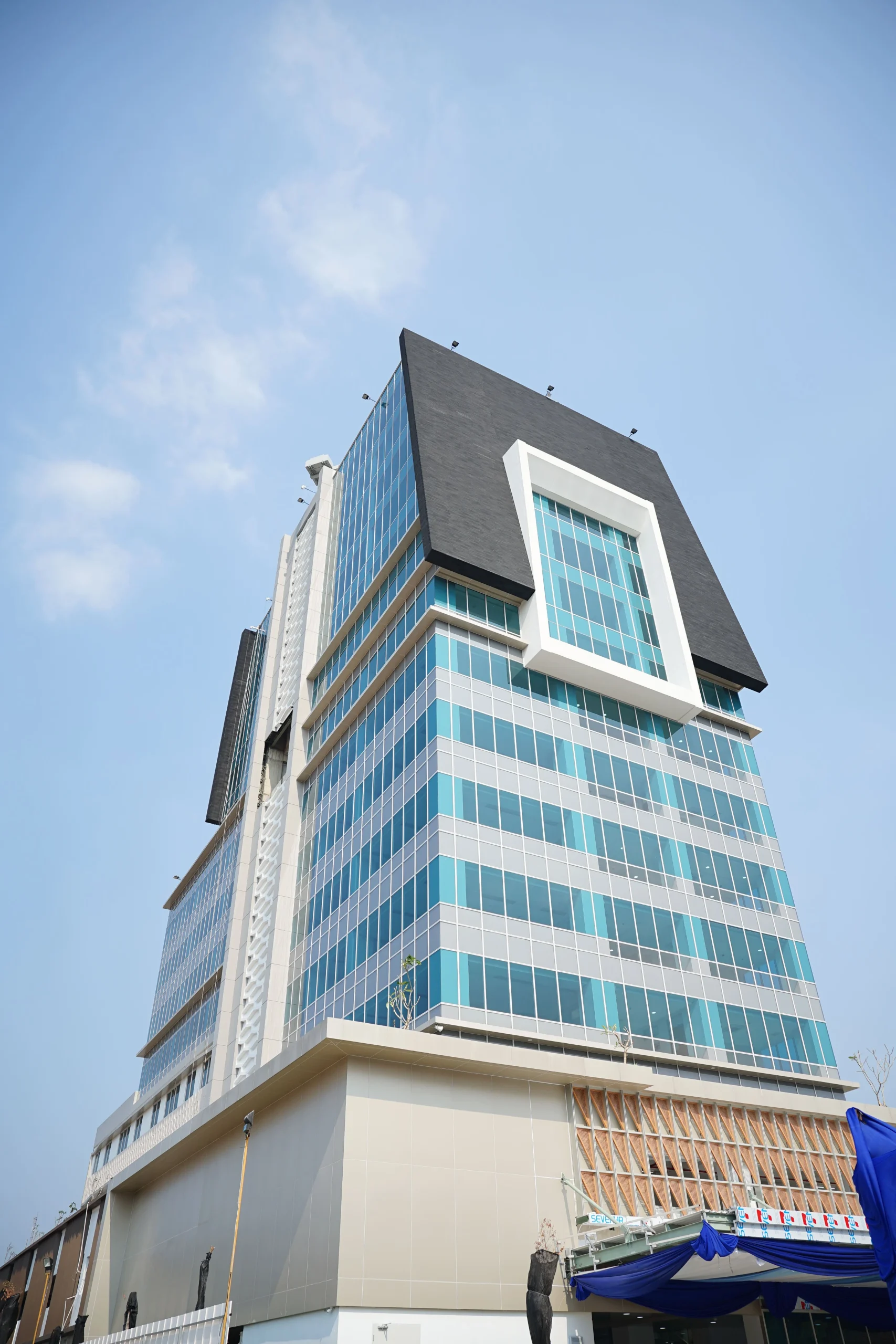
The development of Twin Tower 1 and an integrated vocational education environment at UNDIP’s Pleburan Campus creates an important opportunity to build a more modern and interconnected learning environment.
But we should always remember:
A building is not a World-Class Vocational School.
A building is its home.
A World-Class Vocational School is the living ecosystem within it.
It comes alive when students from different disciplines work together. When faculty and industry create innovations. When laboratories produce solutions. When teaching factories become authentic learning environments. When media carry ideas and innovations to the world. When the campus itself becomes a laboratory for sustainability.
World-class facilities become meaningful only when they enable world-class educational experiences.
From Excellence to Impact
Ultimately, all these ecosystems must converge on one destination:
Real-World Impact.
Real-World Impact is the tangible benefit generated through education, applied research, innovation, and collaboration for industry, society, the environment, and sustainable development.
Impact does not always have to begin on a grand scale.
When students create a tool that makes work more efficient, that is impact.
When research helps an industry reduce its energy or material consumption, that is impact.
When a digital system improves public services, that is impact.
When graduates perform professionally in global environments, that is impact.
When university innovation helps communities improve their quality of life, that too is impact.
Impact may begin locally, grow nationally, and eventually reach the world.
Becoming world-class, therefore, does not have to begin with a desire to appear impressive in the eyes of the world.
It can begin with the ability to solve real problems according to the highest standards we can achieve.
Our Manifesto
As the Vocational School of Diponegoro University enters its second decade, we believe that vocational education carries an increasingly important responsibility.
We believe that knowledge must lead to capability.
We believe that capability must produce tangible work.
We believe that tangible work must evolve into solutions.
We believe that industry is not merely an employer of graduates, but a partner in education and innovation.
We believe that technology, including Artificial Intelligence, must strengthen human capability.
We believe that internationalization is not merely about mobility, but about developing people who can contribute globally.
We believe that applied research must find pathways toward users and tangible benefits.
We believe that sustainability is not merely something to be taught, but something to be lived.
And ultimately, we believe that excellence finds its true meaning not in recognition alone, but in the value it creates for others.
This is the meaning of a World-Class Vocational School that we seek to build.
Not an institution that simply wants to be known by the world.
But an institution whose competencies are needed, whose work is used, whose innovations provide solutions, whose graduates make meaningful contributions, and whose presence creates real benefits for the world.
Our journey toward 2030, therefore, is not simply a journey toward global recognition.
It is a journey from excellence to impact.
From knowledge to capability.
From capability to tangible work.
From tangible work to solutions.
And from solutions to real-world impact.
A World-Class Vocational School is not a destination defined merely by global recognition. It is a commitment to creating meaningful impact for the world.
Vocational Skills to Real-World Impact.