
The Highest Purpose of Vocational Education
Oleh: Prof. Dr. Ir. Budiyono, M.Si. – Dekan Sekolah Vokasi Universitas Diponegoro

For years, vocational education has often been associated with competence, employability, industry collaboration, professional certification, internships, and Teaching Factory-based learning. These elements are essential. They help students develop practical skills, professional knowledge, and readiness to enter the world of work.
However, vocational education should not stop there.
At its highest level, vocational education must answer a deeper question:
What meaningful contribution does it create for the real world?
This is where the concept of Real-World Impact becomes important.
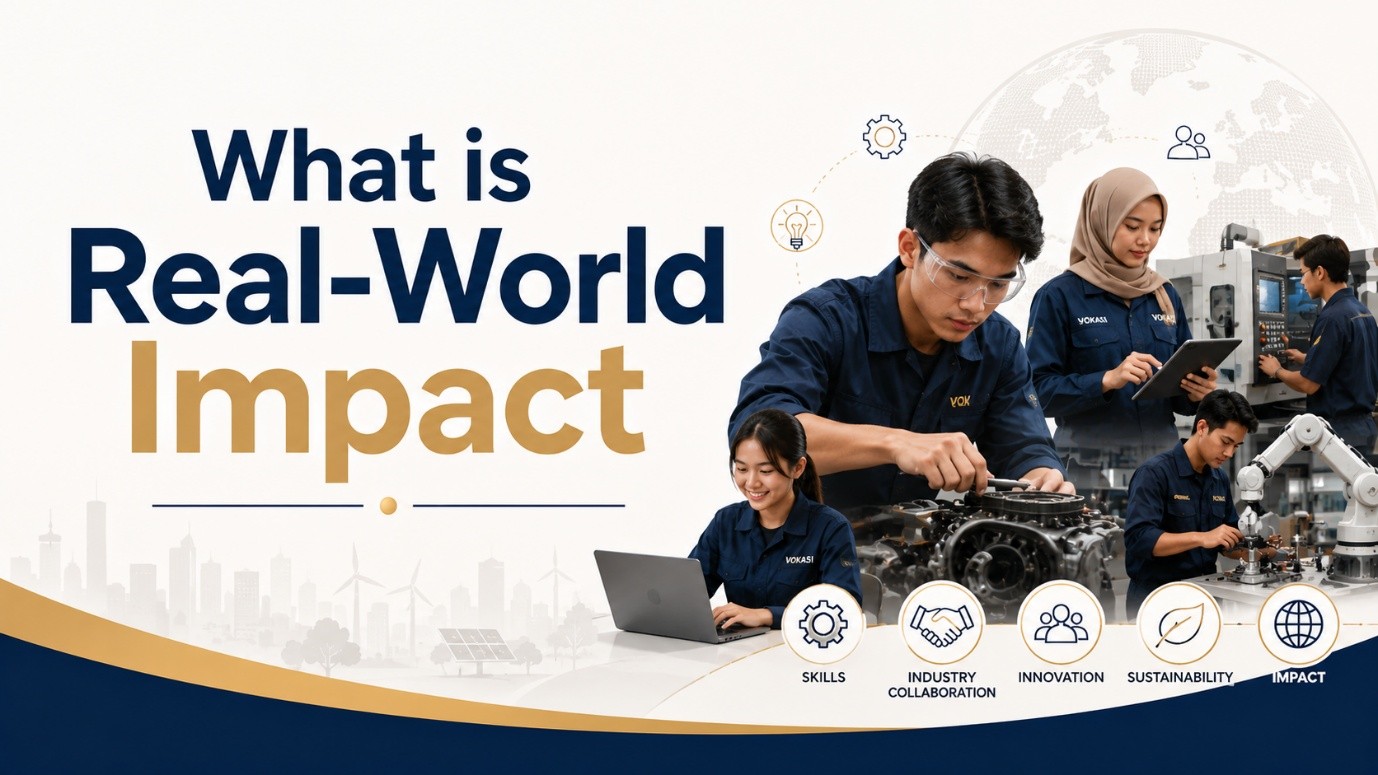
Real-World Impact refers to the tangible and meaningful benefits created by education, applied research, innovation, and collaboration for industry, society, the environment, and sustainable development. It is the point where competence is transformed into solutions, solutions become benefits, and benefits create positive change in the real world.
In vocational education, learning does not end in the classroom. It begins there.
Students learn, practice, experiment, collaborate, innovate, and eventually apply their competencies to solve real problems. When those competencies create value for others—whether in industry, business, communities, public services, or the environment—they become part of Real-World Impact.
This is why competence is the starting point, but Real-World Impact is the destination.
For the Vocational School of Diponegoro University (UNDIP), Real-World Impact is not merely a phrase. It is an institutional direction. As part of its transformation toward a World-Class Vocational School, the Vocational School of UNDIP is committed to creating Real-World Impact through Applied Research, Industry Engagement, Global Employability, Sustainability, Character Development, and Innovation.
Through Applied Research, knowledge is translated into practical solutions. Through Industry Engagement, education is connected to the real needs of the world of work. Through Global Employability, graduates are prepared to compete and contribute beyond national borders. Through Sustainability, innovation is directed toward long-term benefits for people and the planet. Through Character Development, students are shaped not only to be competent, but also ethical, responsible, and professional. Through Innovation, ideas are transformed into products, services, systems, and solutions that create value.
In this sense, a World-Class Vocational School is not defined only by facilities, rankings, technology, or international recognition. Those achievements are important, but they are not the final destination.
A truly world-class vocational institution is one that consistently creates Real-World Impact.
The impact may begin locally, grow nationally, and contribute globally. A student innovation that improves productivity in an industry creates Real-World Impact. An applied research project that helps reduce waste or improve water quality creates Real-World Impact. A community program that strengthens skills and livelihoods creates Real-World Impact. A graduate who contributes professionally in the global workforce also creates Real-World Impact.
In today’s rapidly changing world, this orientation is increasingly important. Digital transformation, artificial intelligence, climate change, energy transition, industrial disruption, and global labor mobility require vocational institutions to produce more than job-ready graduates. The world needs professionals who can solve problems, create value, and bring positive change.
That is why the Vocational School of UNDIP continues to strengthen its Vocational Excellence Ecosystem 2030, supported by Artificial Intelligence as a Strategic Enabler, Integrated Teaching Factory, applied media, global visibility, sustainability initiatives, and industry-based learning. All of these efforts are directed toward one larger purpose: creating Real-World Impact for industry, society, and sustainable development.
Ultimately, vocational education finds its greatest meaning when it becomes useful beyond itself.
Not only when students learn, but when they apply.
Not only when graduates work, but when they contribute.
Not only when innovation is created, but when it improves lives.
Vocational education reaches its highest purpose when competence becomes solutions, solutions become benefits, and benefits create Real-World Impact.
This is the spirit behind the transformation of the Vocational School of Diponegoro University:
Vocational Skills to Real-World Impact.
Tags. Real-World Impact, World Class Vocational School, Vocational Education, Applied Research, Industry Engagement, Global Employability, Innovation, Sustainability, Character Development, Artificial Intelligence, Teaching Factory, Experiential Learning, Higher Education, Vocational School, Diponegoro University, UNDIP